

The phone call usually comes before the grief has settled. A parent has passed, and now there’s a house, and now there are siblings who each have an opinion about what should happen to it. Selling an inherited house with siblings sounds like it should be simple math: split the value, sign the papers, move on. In practice, it’s rarely that clean, and almost nobody warns you about the parts that actually slow things down.
If you’re standing in your childhood kitchen right now, wondering how three or four adults who love each other but disagree about almost everything are supposed to agree on this, you’re not doing anything wrong. This is just genuinely one of the harder things a family goes through, and most of what makes it hard never gets mentioned until you’re already in the middle of it.
You’re Legal Co-Owners Whether You Like It or Not
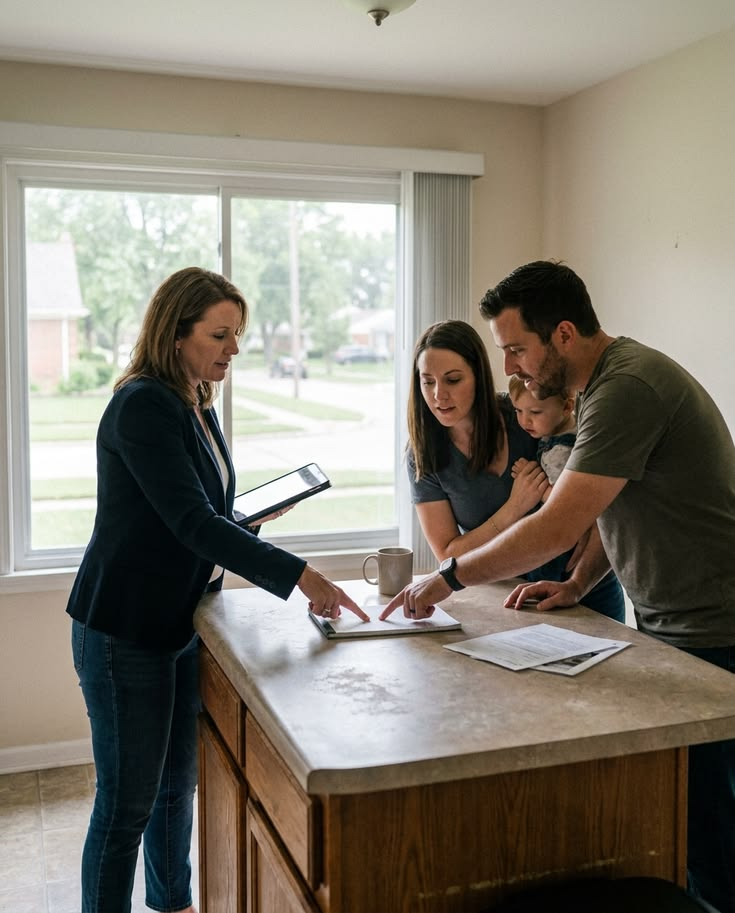
When a parent leaves a house to more than one child without specifying how it should be divided, Illinois law generally treats the siblings as tenants in common. That means each of you owns an undivided share of the whole property, not a specific room or a slice of the yard. Nobody can sell, rent, or take out a loan against the house without either everyone’s cooperation or a court’s involvement.
This surprises people. Families often assume that because they’re related, some informal understanding will carry the day. But a title company will not insure a sale unless every single owner signs off, and a lender will not touch the property either. If even one sibling is unreachable, unwilling, or simply dragging their feet, the house is effectively frozen. Selling an inherited house with siblings, when everyone actually agrees, can move quickly. When even one person holds out, everything stalls.
A question that comes up constantly in this situation is whether a sibling can be forced to sell. In Illinois, the answer is yes, through a partition action filed under 735 ILCS 5/17-101, which allows any co-owner to ask a circuit court to either physically divide the property or order it sold and the proceeds split.
For a single-family house, physical division rarely happens, so courts typically order a sale by partition. It’s a real legal tool, but it’s also slow, it costs money in attorney fees and court costs, and it tends to leave lasting damage between siblings who might otherwise have worked things out on their own.
Why Illinois Adds Its Own Layer of Complication
Before siblings can even argue about what to do with the house, there’s often a question of whether probate is required at all. If the parent held the home solely in their own name, without a transfer-on-death instrument or joint tenancy, the property typically has to go through probate before it can be sold. In Illinois, that process commonly takes a year or more, and Cook County alone charges a few hundred dollars just to open a case, before attorney fees, which often run several thousand dollars for even an uncomplicated estate.
A lot of families hope the small estate affidavit will let them skip all of this. Illinois raised that threshold from $100,000 to $150,000 in 2025, and vehicles no longer count toward the limit, which helps more modest estates avoid formal probate entirely. The catch, and it’s an important one, is that the small estate affidavit generally cannot transfer clean title to real estate.
If your parent owned the house outright and there’s no transfer-on-death deed or joint tenancy already in place, the affidavit that works fine for the bank account will not help with the house. You can find the specifics of how Cook County’s Probate Division handles estate filings directly through the Clerk of the Circuit Court of Cook County.
Once probate is open, an executor named in the will, or an administrator appointed by the court if there is no will, generally has authority to sell the property, sometimes without needing separate court approval if the estate is under independent administration. That’s a meaningful detail, because it means one sibling acting as executor may have more legal authority over the timeline than the others realize, which itself becomes a source of friction if it isn’t discussed openly early on.
When One Sibling Wants to Sell and Another Doesn’t
This is the scenario nobody prepares you for. One sibling needs the cash, maybe from job loss or medical bills. Another sibling is attached to the house, or is living in it, or simply isn’t ready to let go of the last place that still feels like their parent’s home. Both positions are completely understandable, and both are also completely incompatible if nothing changes.
A few realistic paths tend to open up once a family reaches this point.
#1. A buyout, where the sibling who wants to keep the house pays the others their share of its fair market value, usually based on an independent appraisal, so nobody feels like the number was picked out of thin air.
#2. A negotiated timeline, where the siblings agree the house will be listed or sold by a certain date, giving the reluctant sibling time to adjust without giving anyone an open-ended veto.
#3. Mediation, which is far less expensive and far less damaging to the relationship than litigation, and which many Illinois probate attorneys recommend before anyone files anything in court.
#4. A partition action, used only when the first three options have genuinely failed, since it hands the decision to a judge and strips the family of control over price, timing, and buyer.
The sibling living in the house without paying rent is its own common flashpoint. That sibling’s occupancy does not, by itself, prevent the other co-owners from pursuing a sale, but it does complicate the numbers, since a court may need to account for fair rental value when dividing proceeds. Getting ahead of that conversation, rather than letting resentment build silently for months, tends to save real money and real relationships.

The Money Question Almost Nobody Explains Correctly
Here’s something that genuinely surprises a lot of heirs in a good way. Because of a rule called the step-up in basis, your tax basis in an inherited house is generally reset to its fair market value on the date your parent died, not what your parent originally paid for it decades earlier. According to the IRS in Publication 551, this means that if the house is sold reasonably close to that value, there may be little or no taxable capital gain at all, even if your parent bought the home for a fraction of what it’s worth today.
That relief has limits worth understanding. The valuable $250,000 (or $500,000 for a married couple) capital gains exclusion under Section 121, described in IRS Topic 701, generally only applies if you actually lived in the home as your primary residence for two of the five years before selling it.
Most heirs selling an inherited house with siblings haven’t lived there, so that particular exclusion usually doesn’t apply to them, though the step-up in basis still does the heavy lifting in most cases. If the home has sat for a while and the market has moved, or if repairs were made and later reimbursed from estate funds, it’s worth talking to a tax professional before assuming the sale is entirely tax-free.
Money conversations between siblings go smoother when everyone is working from the same numbers rather than guesses. An independent appraisal, or at minimum a few comparable local sales pulled from the current market, gives the family something objective to anchor to instead of arguing from memory or nostalgia.
The Part That Isn’t About Money at All
Somewhere in the middle of appraisals and attorney calls, most families run into the part that actually hurts the most, which is that the house was never just a house. It’s the kitchen table everyone did homework at, the driveway someone learned to drive in, the room that still smells faintly like a parent who is gone. Selling an inherited house with siblings forces four or five different grieving processes to somehow sync up on a real estate timeline, and they rarely do.
It helps to name that out loud rather than pretending the disagreement is purely logistical. A sibling who seems to be stalling on paperwork might actually be stalling on saying goodbye. A sibling who wants to sell immediately might be trying to avoid sitting with grief by staying busy. Neither instinct is wrong, but confusing one for the other, assuming stalling means greed or urgency means coldness, is where a lot of unnecessary family damage happens.
Dividing the personal belongings inside the house is its own emotional minefield, separate from the real estate itself. Families that do this well tend to slow down rather than rush, going room by room, letting each sibling flag a handful of meaningful items before anything is sold, donated, or thrown out. It rarely needs to be complicated, but it does need to be intentional.
When the Family Just Wants This Over
Sometimes, after months of appraisals, attorney calls, and family group chats that have gone quiet in a bad way, everyone reaches the same conclusion at once: nobody wants to keep the house, and everyone just wants it sold with the least amount of additional conflict possible. If the property also needs repairs nobody has the time, money, or shared willingness to coordinate; a traditional listing can add more stress than it solves, since it typically requires all heirs to agree on pricing, staging, showings, and negotiations, all while the clock on holding costs keeps running.
This is where a cash buyer can genuinely simplify things for a family that has already been through enough. Dynasty Buys Homes purchases houses across Cook and Will County in the Chicago Southland as-is, which means no repairs, no showings, and one straightforward transaction that doesn’t require the siblings to agree on paint colors or negotiation strategy, only on the final number.
You can see how the cash-offer process actually works and what to expect at closing, or read specifically about selling an inherited property and selling a house that’s currently in probate, since a cash sale can often be structured to close as soon as probate clears rather than waiting additional months for a retail buyer’s financing.
Families dealing with liens, unpaid property taxes, or other title complications that surfaced during the estate process may also want to look at how title and tax issues get resolved before closing, since these often show up unexpectedly once a title company runs a full search on an inherited home.
And if the house genuinely needs work nobody wants to take on, it’s worth understanding what it actually means to sell a house as-is before assuming repairs are mandatory. Families weighing a fast sale against a traditional listing sometimes also want a clear-eyed comparison of what each route actually nets before deciding.
If you’re specifically located in the south suburbs, whether that’s Homewood, Tinley Park, Harvey, or one of the other Cook and Will County communities Dynasty serves, local knowledge of that specific market can make the appraisal and offer numbers feel more grounded to siblings who are naturally skeptical of a fast process.
Keeping This From Becoming a Legal Fight
A handful of practical habits tend to separate the families who get through this reasonably intact from the ones who end up in court.
#1. Get everything in writing early, even a simple group text confirming who agrees to what, since memories diverge fast under stress and grief.
#2. Order one independent appraisal that everyone agrees to trust, rather than each sibling privately gathering numbers that support what they already wanted.
#3. Loop in an Illinois probate or estate attorney before positions harden, not after, since a short consultation early on is far cheaper than a partition filing later.
#4. Separate the emotional conversation from the financial one on purpose, even scheduling them as different calls, so grief and dollar amounts don’t get tangled together.
#5. Set a realistic deadline everyone agrees to in advance, so the process has a natural endpoint instead of dragging indefinitely.
#6. Consider a neutral third party, whether that’s a mediator, an attorney, or a cash buyer who removes the subjectivity of listing price negotiations entirely.
Selling an inherited house with siblings will probably never feel entirely easy, because it isn’t just a transaction; it’s the last shared decision a family makes about a place that mattered to all of you. But it doesn’t have to become the thing that breaks the family either.
With clear information, honest conversations, and a plan everyone actually agreed to rather than one that got forced through, most families get to the other side of this still speaking to each other, which, in the end, is worth more than any number on a closing statement.