

If you’re behind on your mortgage or owe more than your Indiana home is worth, you’ve likely come across two very different paths forward: a short sale or a cash sale.
Understanding short sale vs. cash sale in Indiana is critical before you decide, because these two options work completely differently, involve different timelines, and carry different levels of stress and financial risk.
This guide breaks down exactly how each option works, who they’re best suited for, and how to decide which one fits your situation.
What Is the Difference Between a Short Sale and a Cash Sale?
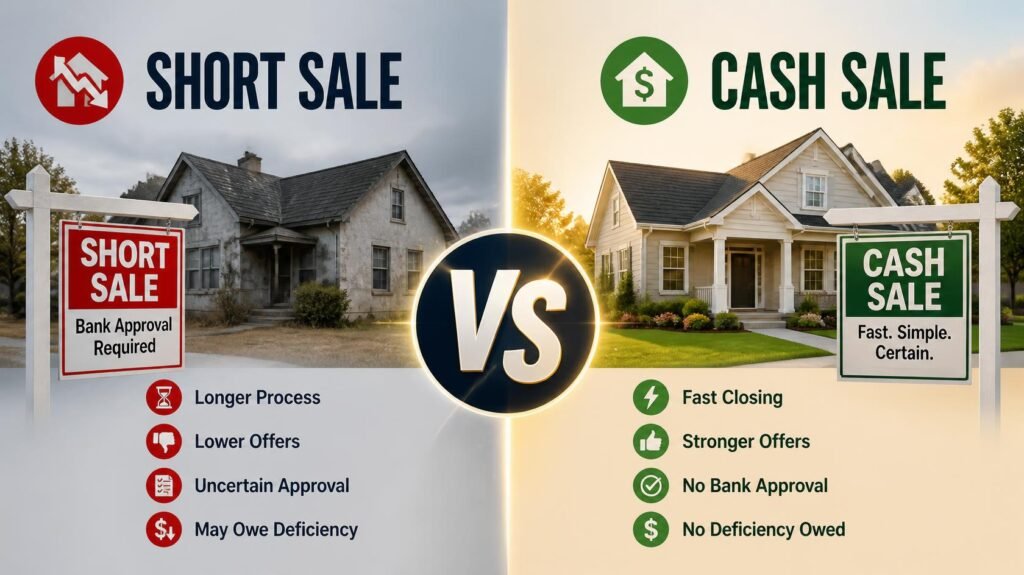
Before comparing the two side by side, it’s important to understand what each term actually means, since the short sale vs cash sale in Indiana decision hinges on two very different processes.
A short sale happens when you owe more on your mortgage than your home is currently worth, and your lender agrees to let you sell the home for less than the outstanding loan balance. The lender must approve the sale price, and the process typically requires documentation of financial hardship.
A cash sale simply means selling your home directly to a cash buyer or investor, usually without a real estate agent, without lender approval requirements (unless you’re behind on payments), and often with a fast, flexible closing timeline.
These options aren’t mutually exclusive in every case; some homeowners facing financial hardship qualify for either path, which is why the short sale vs cash sale in Indiana comparison matters so much.
How a Short Sale Works in Indiana
The Short Sale Process Step-by-Step
A short sale in Indiana generally follows these steps:
#1. Prove financial hardship to your lender (job loss, medical bills, divorce, etc.)
#2. List the home with a real estate agent experienced in short sales
#3. Receive an offer from a buyer
#4. Submit the offer to your lender for approval, along with hardship documentation
#5. Wait for lender review, which can take weeks or even months
#6. Close the sale, once the lender formally approves the price and terms
Short sales require significant lender involvement, which is one of the biggest differences in the short sale vs cash sale in Indiana comparison a cash sale skips this approval process almost entirely unless you’re also behind on your mortgage.
Short Sale vs Cash Sale in Indiana: Who Qualifies for Each?
Not everyone can pursue a short sale. Lenders typically require:
- Proof of financial hardship
- A home currently worth less than the mortgage balance
- Missed payments or an imminent risk of default
- Full financial disclosure, including income, assets, and debts
If you don’t meet these requirements, a short sale may not even be an option which naturally pushes many Indiana homeowners toward a cash sale instead.
How a Cash Sale Works in Indiana
A cash sale in Indiana is far simpler and doesn’t require lender approval unless you’re already delinquent on your mortgage. The typical process looks like this:
#1. Request a cash offer from a home-buying company or investor
#2. Receive an offer, often within 24–48 hours
#3. Skip repairs and showings; most cash buyers purchase as-is
#4. Choose your closing date, sometimes in as little as 7–14 days
#5. Close and receive proceeds, or in some cases, have the sale directly pay off your mortgage balance
If you owe less than your home is worth, a cash sale lets you walk away with proceeds. If you owe more, the cash buyer or a knowledgeable agent can still help coordinate a short sale-style cash transaction with lender approval, blending both worlds.
Short Sale vs Cash Sale in Indiana: Side-by-Side Comparison
| Factor | Short Sale | Cash Sale |
| Lender approval required | Yes | Only if behind on payments |
| Credit impact | Moderate to significant | Minimal (if current on payments) |
| Timeline | 60–120+ days | 7–14 days |
| Repairs required | Sometimes | Usually none |
| Financial hardship required | Yes | No |
| Certainty of closing | Lower (lender can reject) | High |
| Best for | Underwater mortgages | Speed, simplicity, or avoiding foreclosure |
This table highlights exactly why the decision often comes down to one factor: whether you owe more than your home is worth, and how much time you realistically have before foreclosure becomes a risk.
Short Sale vs Cash Sale in Indiana: Pros and Cons

Pros and Cons of a Short Sale
Pros:
- Can help you avoid foreclosure on your record
- May allow you to walk away from an underwater mortgage without owing the full deficiency (depending on lender terms)
- Can be a lifeline when you have no equity and can’t afford to keep the home
Cons:
- Requires lender approval, which can take months
- Still impacts your credit score, though typically less severely than foreclosure
- Not guaranteed; lenders can reject offers or delay indefinitely
- Emotionally and administratively stressful due to extensive documentation
Pros and Cons of a Cash Sale
Pros:
- Fast closing, often within two weeks
- No repairs, staging, or showings required
- High certainty cash offers rarely fall through
- Simpler paperwork compared to a lender-approved short sale
Cons:
- Lower sale price than a fully marketed listing
- Only avoids lender involvement if you’re current on payments
- If you’re underwater and behind on payments, you may still need lender cooperation, blending it with short sale requirements
Which Situation Fits Which Option?
When a Short Sale Makes More Sense
A short sale is typically the better fit when:
- You owe significantly more than your home is worth
- You’re already behind on mortgage payments
- You have documented financial hardship
- You have time to wait out a lengthy lender approval process
- Avoiding foreclosure on your credit report is a top priority
When a Cash Sale Makes More Sense
A cash sale is typically the better fit when:
- You have equity in your home, or owe close to what it’s worth
- You need to sell quickly, regardless of hardship status
- You want to avoid lender approval delays entirely
- Your home needs repairs you can’t afford before selling
- Certainty of closing matters more than maximizing sale price
How to Decide: A Quick Self-Assessment
Ask yourself these questions to work through this decision for your own situation:
Do you owe more on your mortgage than your home is worth? If yes, a short sale may be necessary, since a cash buyer can’t pay more than the home’s current value.
Are you behind on mortgage payments or facing foreclosure risk? This strengthens the case for exploring a short sale, though a fast cash sale can sometimes outrun the foreclosure timeline entirely.
Do you have equity, or owe less than the home is worth? A cash sale is likely your simpler, faster option, with no lender approval needed.
Can you wait 60–120+ days for lender approval? If not, a cash sale’s speed becomes even more valuable, especially if foreclosure is approaching.
Frequently Asked Questions
Can I do a cash sale if I’m underwater on my mortgage? Yes, but if you owe more than the home is worth, your lender will still need to approve the reduced payoff amount, effectively turning it into a short sale, just with a cash buyer instead of a traditional buyer.
Does a short sale hurt my credit more than a cash sale? Generally, yes. A short sale is reported to credit bureaus and can lower your score, though usually less severely than a foreclosure. A cash sale, if you’re current on payments, typically has no negative credit impact.
How fast can a cash sale close compared to a short sale? A cash sale can often close in 7–14 days, while a short sale typically takes 60–120 days or longer due to lender review and approval requirements.
Is a short sale always the better option if I’m underwater? Not necessarily. Some cash buyers are experienced in negotiating short sale approvals directly with lenders, which can combine the speed of a cash sale with the debt relief of a short sale.
What happens if my lender rejects a short sale offer? If a lender rejects the offer, you may need to submit a new offer, adjust terms, or explore other options like a cash sale, loan modification, or, in worst cases, foreclosure.
Final Thoughts
The short sale vs. cash sale in Indiana decision ultimately comes down to your mortgage balance, your timeline, and whether your lender needs to be involved.
If you’re underwater and facing financial hardship, a short sale may be your only path to avoiding foreclosure, even though it takes longer and impacts your credit. If you have equity or simply need to sell quickly and with certainty, a cash sale offers a faster, simpler route with far less lender involvement.
Whichever direction you’re leaning, talk to a knowledgeable real estate professional or housing counselor before committing. Comparing your real numbers payoff balance, home value, and timeline is the only way to know for certain which option truly protects your finances and your peace of mind.