

A few lines on a closing statement confuse sellers and buyers as much as the property tax credit. You see a number that does not match your last tax bill, and you wonder who is paying whom and why.
Understanding Indiana property tax proration before you sit down at the closing table can save you from surprises and help you negotiate with confidence.
This guide explains how property tax proration works in Indiana transactions, how the math is calculated, and what sellers and buyers should check before closing. We will use plain language and a simple example so the numbers make sense.
What Is Property Tax Proration?
Property tax proration is the process of dividing the annual tax bill between the seller and the buyer. Each party pays for the period during which they owned the home.
The goal is fairness. A seller should not pay taxes for months the buyer will own the house, and a buyer should not pay for months the seller lived there.
At closing, the title company calculates each side’s share and adjusts the settlement statement. One party receives a credit, and the other receives a matching charge.
Indiana property tax proration follows this same basic idea, but Indiana has a few timing rules that make the calculation different from many other states.
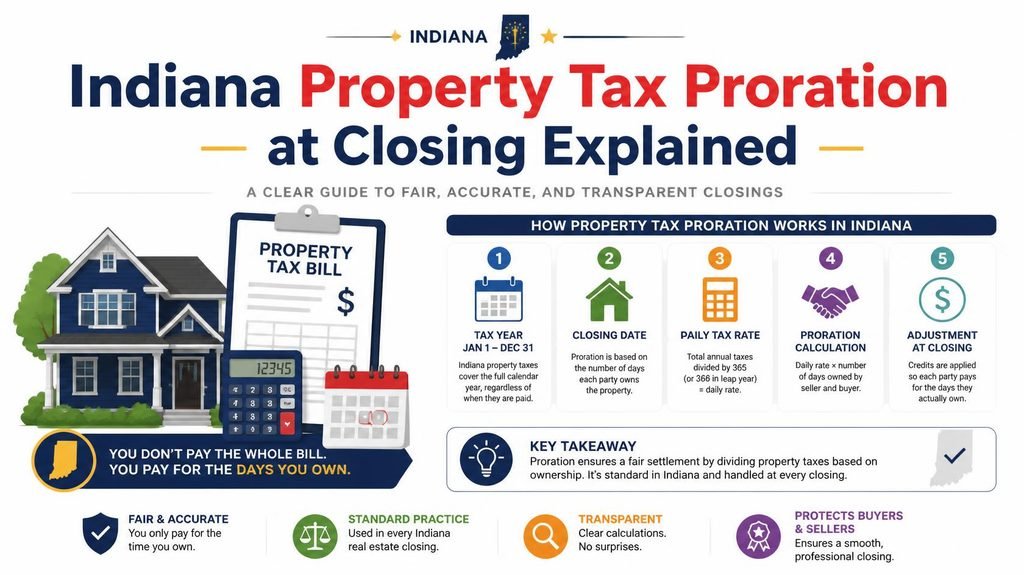
How Indiana Property Taxes Work
Indiana property taxes are paid in arrears. That means taxes for one year are billed and paid during the following year.
For example, the taxes that accrue during 2026 are generally billed in 2027. This is the single most important fact behind property tax proration in Indiana closings.
Bills are normally paid in two installments each year. The spring installment is due May 10, and the fall installment is due November 10.
Because of this schedule, a seller who closes midyear often owes taxes that have been building up but have not yet been billed. The proration covers that gap.
The Basic Formula
Most title companies calculate a daily rate and multiply it by the number of days the seller owned the property. The formula is simple.
Divide the annual tax amount by 365 to get the daily tax cost. Then multiply that number by the number of days the seller owned the home during the tax year.
Some contracts use a 360-day year with 30-day months instead. The purchase agreement should state which method applies, so check that section before closing.
Because Indiana property tax proration depends on the contract language, the exact result can vary slightly from one transaction to another.
A Simple Example
Imagine a home with annual property taxes of $3,650. Divided by 365, the daily cost is exactly $10.
Suppose the sale closes on June 15, 2026. The seller owned the home for 166 days of that year, counting the closing day as a seller day.
Multiply 166 days by $10, and the seller’s share is $1,660. Those taxes will not be billed until 2027, so the seller gives the buyer a $1,660 credit at closing.
The buyer then pays the full 2026 tax bill when it arrives in 2027. The credit they received at closing helps cover the seller’s portion.
This is the heart of property tax proration Indiana buyers and sellers experience. The seller pays through a credit, and the buyer handles the actual bill later.
How Closing Date Changes the Math
The time of year you close affects what is owed. Customary practice breaks down roughly into three windows, though your contract controls the final result.
Closing from January through early May. Neither installment of the prior year’s bill has been paid yet. The seller usually credits the buyer for the full prior year tax bill, plus the current year’s accrued share from January 1 to closing.
Closing between May 10 and November 10. The spring installment should already be paid. The seller generally credits the buyer for the unpaid fall installment, plus the current year’s accrued share.
Closing after November 10. The prior year’s taxes should be fully paid. The seller only owes the current year’s accrued share from January 1 to the closing date.
Because Indiana property tax proration can involve both a prior-year bill and a current-year accrual, sellers should ask the title company to show both calculations clearly.
Estimates and Proration
The current year’s final tax bill is rarely known at closing. Title companies usually estimate using the most recent bill available.
If the actual bill turns out higher or lower, the parties may have agreed to a reproration once the final numbers are available. Without that clause, the original estimate generally stands.
Reproration can matter more than people expect. Assessed values, local tax rates, and available deductions can all change from one year to the next.
If your purchase agreement is silent on this point, ask your agent or attorney whether you want a clause that allows a true-up later. Sellers and buyers both benefit from clarity.

Homestead Deductions and Their Effect
Many Indiana homeowners receive deductions that lower their tax bills. A seller’s homestead deduction does not automatically transfer to the next owner.
A buyer who plans to live in the home generally needs to apply for their own deductions with the county. Deadlines and forms can change, so confirm current rules with the county auditor’s office.
This matters for proration because the bill used for the estimate may reflect the seller’s lower, deducted amount. The buyer’s actual bill could be higher before their own deductions take effect.
Buyers should plan for that possibility when budgeting. Sellers should understand that a reproration request is more likely when the numbers shift significantly.
Escrow, Lenders, and Tax Payments
Buyers using a mortgage often pay property taxes through an escrow account. The lender collects a portion each month and pays the bill when it comes due.
At closing, the lender may require an initial escrow deposit. This is separate from property tax proration and Indiana credits, even though both appear on the same settlement statement.
Do not confuse the two. The proration credit settles who owes what between buyer and seller, while the escrow deposit funds the buyer’s future payments.
If you are unsure which line item is which, ask the closing agent to walk you through the settlement statement before you sign.
Delinquent Taxes and Other Surprises
Unpaid taxes from earlier years are a different matter from normal proration. Delinquent amounts, penalties, and interest generally must be paid at or before closing.
Title companies find these items during the title search. A seller who has fallen behind will typically see the balance deducted from their proceeds.
Persistent delinquency can eventually lead to a tax sale, which creates serious complications for anyone trying to sell. If you are behind, address it as early as possible.
Sellers dealing with back taxes, liens, or inherited properties should speak with a title company and, when needed, an attorney about the safest path forward.
Tips for Sellers
Request a current tax bill and payment history before you list. Knowing what has been paid and what is outstanding prevents last-minute confusion.
Review the proration language in your purchase agreement. Confirm the day count method and whether the closing day belongs to you or the buyer.
Ask the title company for a draft settlement statement a few days before closing. Check that the Indiana property tax proration figures match your own estimate.
Keep proof of any payments you made. If a dispute arises later, receipts and county records are your best evidence.
Tips for Buyers
Ask for the most recent tax bill and look at which deductions are included. Estimate what your own bill might look like once your deductions apply.
Confirm which installment is due next after closing. Know the date so you aren’t caught off guard by a bill you didn’t expect.
Make sure the credit you receive matches the days the seller owned the home. A quick calculator check can catch errors before they become expensive.
Ask whether the contract includes a reproration clause. If not, consider whether the estimate leaves you with a meaningful risk.
Common Mistakes to Avoid
One mistake is assuming the seller owes nothing because the tax bill has not arrived. In Indiana, those unbilled taxes are still real, and the proration covers them.
Another is relying on a verbal agreement. Anything about property tax proration that Indiana parties expect should appear in writing in the contract.
A third mistake is ignoring the settlement statement until the closing table. Reviewing it early gives everyone time to correct errors without pressure.
Frequently Asked Questions
What is Indiana property tax proration?
It is the division of the annual tax bill between buyer and seller based on how long each party owned the home during the tax year.
Why does the seller credit the buyer in Indiana?
Indiana taxes are paid in arrears, so the buyer receives the full bill later. The seller’s credit covers the portion of the year the seller owned the property.
When are Indiana property taxes due?
Installments are generally due May 10 and November 10 each year. Always verify current dates with your county treasurer.
Who calculates the proration at closing?
The title company or closing agent normally prepares the calculation using the purchase agreement and the latest tax information.
Can the proration change after closing?
Yes, if your contract includes a reproration clause. Otherwise, the estimate used at closing usually stays final.
Does a cash sale change how proration works?
No. Cash and financed sales use the same proration concept, although a cash buyer will not have a lender escrow account.
What if the seller has unpaid back taxes?
Delinquent taxes, penalties, and interest typically must be paid at closing, often from the seller’s proceeds.
Is this tax or legal advice?
No. This guide is general information, so confirm details with your title company, a real estate attorney, or the county auditor.
Moving Forward With Confidence
Understanding Indiana property tax proration turns a confusing line item into a simple, fair adjustment. Once you know the arrears system, the daily rate formula, and the role of the contract, the numbers become much easier to follow.
If you are selling a home in Northwest Indiana and want a straightforward closing, Dynastybuyshomes can walk you through the process and explain every line of your settlement statement. Reach out today to talk through your situation and receive a no-obligation cash offer.