

Three of Northwest Indiana’s most distinct communities Hammond, Merrillville, and Valparaiso, offer a useful window into just how differently property value trends can play out even within the same broader region.
Each city has its own economic base, housing stock, and relationship to the Chicago metro area, and understanding property value trends in Hammond, Merrillville, and Valparaiso side by side reveals patterns that a single regional average would miss entirely.
This post breaks down what’s shaping values in each of these three communities, how they compare, and what homeowners in any of the three should take away when thinking about their own property.
Why Comparing These Three Cities Makes Sense
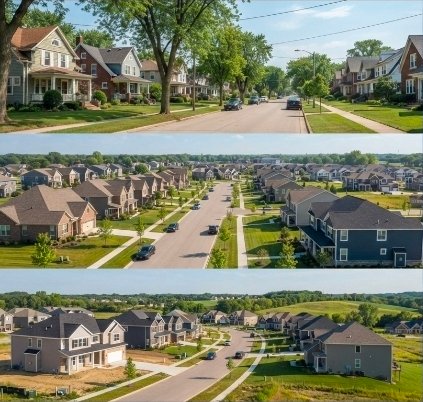
Hammond, Merrillville, and Valparaiso represent three genuinely different positions within Northwest Indiana’s broader housing landscape.
Hammond sits directly on the Chicago border, shaped heavily by commuter demand and an older, established housing stock.
Merrillville is more centrally located in Lake County, with strong commercial corridors and a suburban character.
Valparaiso, in Porter County, represents the region’s more organic growth story, further from Chicago but drawing its own steady population growth and new construction activity.
Comparing property value trends across these three communities highlights how proximity, housing stock, and local economic drivers combine differently in each case.
Hammond: Value Trends Shaped by Chicago Proximity
The Affordability Draw
Hammond’s position directly bordering Chicago has remained one of the most consistent drivers of its property value trends.
Buyers priced out of Chicago and its closer suburbs have continued to look toward Hammond for a combination of lower prices, lower property taxes, and a still-manageable commute.
Variation Tied to Housing Stock Age
Hammond’s housing stock spans several distinct eras of development, and property value trends here vary considerably depending on a home’s age, condition, and specific location within the city.
Well-maintained homes near strong highway access have generally seen steadier appreciation than older, less-updated properties in more interior neighborhoods.
Highway Access as a Consistent Value Driver
Proximity to major interstate corridors has remained one of the most reliable predictors of stronger property value trends within Hammond specifically, reflecting the premium many commuter-focused buyers place on convenient access to Chicago.
Merrillville: Value Trends Shaped by Commercial Stability
A Strong Commercial Base Supporting Residential Demand
Merrillville’s significant commercial corridors and retail base have continued to provide economic stability, supporting steadier property value trends compared to some neighboring communities that are more dependent on a single economic driver.
Suburban Character Appealing to Families
Merrillville’s more suburban feel, combined with generally well-regarded schools and services, has continued to draw family buyers, supporting consistent demand across much of the city’s housing stock rather than the more pronounced neighborhood-to-neighborhood variation seen in Hammond.
A More Balanced Mix of New and Established Housing
Merrillville’s combination of established neighborhoods and pockets of newer development has helped create relatively steady property value trends across different housing types, without the more polarized pattern seen in cities with either much older or much newer housing stock dominating.
Valparaiso: Value Trends Shaped by Organic Growth
Population Growth as the Primary Driver
Unlike Hammond’s Chicago-proximity-driven demand, Valparaiso’s property value trends have been shaped more heavily by its own organic population growth, a combination of Chicago-area relocations and in-state moves drawn to the city’s reputation, schools, and amenities.
New Construction Adding Supply, But Not Fully Offsetting Demand
Valparaiso has seen more new residential construction than either Hammond or Merrillville, helping add supply to a market that might otherwise be more constrained.
Even with this new construction, however, demand has generally continued to outpace available inventory, supporting upward pressure on property values in and around the city.
Downtown Proximity as a Premium Factor
Homes near Valparaiso’s walkable downtown and its associated amenities have generally commanded a premium compared to more outlying parts of the city, reflecting the strong draw of the city’s core relative to its surrounding areas.
How Rental Markets Reflect These Same Patterns

Rental conditions across the three cities generally mirror the same forces shaping the for-sale market. Hammond’s rental market has continued to benefit from steady demand from Chicago-area commuters who are not yet ready to buy, particularly near major highway corridors.
Merrillville’s rental demand has remained relatively steady, supported by the same commercial and suburban stability shaping its for-sale market.
Valparaiso’s rental market has felt some of the same population-growth-driven pressure seen in its for-sale segment, with demand from younger households and those relocating to the area but not yet ready to purchase.
For investors evaluating opportunities across these three cities, understanding these parallel rental dynamics adds useful context alongside the for-sale trends discussed throughout this overview, since strong rental demand can support investment decisions even in segments where for-sale competition is particularly intense.
Historical Context: How Each City Got Here
Understanding today’s conditions benefits from a brief look at how each city arrived at its current position. Hammond’s development reflects decades of steady, Chicago-adjacent growth, with its housing stock shaped by multiple distinct building eras stretching back well over a century in some neighborhoods.
Merrillville’s more recent suburban development, concentrated primarily in the mid-to-late twentieth century, produced a more uniform housing stock than Hammond’s older, more varied neighborhoods.
Valparaiso’s continued growth is an ongoing story rather than a completed one, with new construction adding to a housing stock that already reflects decades of steady, organic expansion tied to the city’s reputation and amenities.
This historical context helps explain why the three cities show such different patterns today. Hammond’s variation reflects genuine age diversity in its housing stock; Merrillville’s relative consistency reflects a more concentrated period of development; and Valparaiso’s continued growth reflects an active, ongoing expansion rather than a settled, mature market.
Comparing the Three Cities Side by Side
| Factor | Hammond | Merrillville | Valparaiso |
|---|---|---|---|
| Primary demand driver | Chicago-proximity affordability | Commercial stability, suburban appeal | Organic population growth |
| Housing stock | Older, highly variable | Mix of established and newer | Growing share of new construction |
| Strongest value driver | Highway access | School districts, commercial access | Downtown proximity |
| New construction activity | Limited | Moderate | Relatively high |
| Price point relative to region | Generally most affordable of the three | Mid-range | Generally highest of the three |
This comparison highlights why property value trends in Hammond, Merrillville, and Valparaiso can’t be reduced to a single regional narrative; each city’s specific economic and demographic drivers produce genuinely different patterns.
What This Means for Homeowners in Each City
Hammond Homeowners
Understanding which specific pocket of Hammond your property sits in matters enormously, given the considerable variation across the city.
Homes near major highway corridors have generally seen the steadiest appreciation, while older, more interior properties may face a narrower pool of traditional buyers, making a direct cash sale a realistic option for homeowners in this situation.
Merrillville Homeowners
Merrillville’s more consistent property value trends across much of its housing stock mean homeowners here can generally rely on broader neighborhood comparables with more confidence than in a city like Hammond, where block-level variation matters more.
Valparaiso Homeowners
Homeowners near Valparaiso’s downtown or in well-established neighborhoods have generally benefited from the strongest property value trends in the city, while those in newer, more outlying developments should pay close attention to how new construction in their area affects buyer competition and pricing.
What This Means for Buyers Weighing These Three Cities
Buyers comparing Hammond, Merrillville, and Valparaiso should weigh their own priorities against each city’s specific character.
Those prioritizing the shortest possible Chicago commute at the lowest price point will likely find Hammond’s highway-adjacent neighborhoods most appealing, even accounting for the need to research specific blocks carefully given the city’s internal variation.
Buyers prioritizing suburban consistency, strong schools, and commercial convenience may find Merrillville’s more uniform market easier to navigate with confidence.
Buyers willing to pay a premium for a walkable downtown, strong community amenities, and a city with continued growth momentum may find Valparaiso the best fit, provided their budget accommodates its generally higher price point relative to the other two cities.
Common Factors Affecting All Three Cities
Despite their differences, a few forces shape property value trends across all three communities simultaneously:
Broader interest-rate movements affect buyers’ purchasing power similarly across all three cities, even if the underlying demand drivers differ.
Regional affordability relative to Chicago continues to support demand across the entire area, even as Valparaiso’s organic growth adds a layer of demand not directly tied to proximity to Chicago.
Overall inventory conditions across Northwest Indiana have remained relatively tight in recent years, supporting generally positive property value trends across all three cities, even as the specific pace and drivers vary.
Common Questions About These Three Markets
Which of the three cities has seen the strongest property value trends recently?
It depends on the specific comparison being made. Valparaiso has generally seen strong demand tied to its own population growth, while Hammond’s most desirable pockets near highway access have also performed well. Direct comparisons require looking at specific neighborhoods rather than citywide averages alone.
Is Valparaiso now more expensive than Hammond and Merrillville?
Generally, yes, reflecting its strong demand and reputation, though specific comparisons depend heavily on individual neighborhoods and housing types within each city.
Why does Hammond show more internal variation than Merrillville?
Hammond’s older, more varied housing stock and its wider range of neighborhood conditions create more pronounced block-to-block differences than Merrillville’s more uniform suburban development pattern.
Should I expect my property value trends to mirror the citywide pattern for my city?
Not necessarily. Neighborhood-specific and even block-specific factors often matter more than citywide averages, particularly in a city like Hammond, which has significant internal variation.
Where can I find precise, current property value data for my specific home?
A local real estate professional or a current MLS report focused on your specific neighborhood provides the most reliable, up-to-date figures, since the trends discussed here are meant to provide general context rather than precise valuation.
A Note on Data and Methodology
This overview of property value trends in Hammond, Merrillville, and Valparaiso is intended as a directional summary of regional dynamics rather than a substitute for verified, current statistics.
Specific figures, median prices, appreciation rates, or precise neighborhood-level data shift regularly and are best confirmed through a current local MLS report or a real estate professional familiar with each specific city.
The Bottom Line
Property value trends in Hammond, Merrillville, and Valparaiso reflect three genuinely different stories within the same broader region: Chicago-proximity-driven affordability in Hammond, commercial stability and suburban consistency in Merrillville, and organic population growth in Valparaiso.
For homeowners in any of these three cities, understanding which specific forces are shaping your own neighborhood provides a far more useful foundation for decision-making than assuming a single regional trend applies evenly across all three.
This article offers a general, directional overview of regional market conditions and does not represent verified, current statistical data. Readers are encouraged to consult a local real estate professional or a current MLS report for figures specific to their property and neighborhood.